


Low Cost Counselling UK: A Guide to Finding Quality Affordable Therapy in 2026
Navigating the world of mental health support in the UK can feel like a choice between two extremes: enduring long NHS waiting lists for free services or facing the significant expense of private therapy. For many, especially in high-cost urban centres like London, this leaves a wide, uncertain gap. Yet, in 2026, a third path has become more accessible than ever—affordable private counselling that doesn’t compromise on quality, expertise, or the crucial therapeutic connection.
This guide will help you understand what high-quality, low-cost counselling in the UK truly means. It’s not about settling for less; it’s about finding a sustainable partnership for your mental wellbeing, one that prioritises accredited professionals, cultural understanding, and a supportive structure to guide your journey.
What is Low Cost Counselling in the UK and How Does it Work?
Low-cost counselling refers to professional therapy offered at a reduced rate, bridging the gap between free public services and expensive traditional private practices. It is designed for individuals who need timely support but find typical private fees prohibitive. The key is understanding that “low cost” does not have to mean low quality.
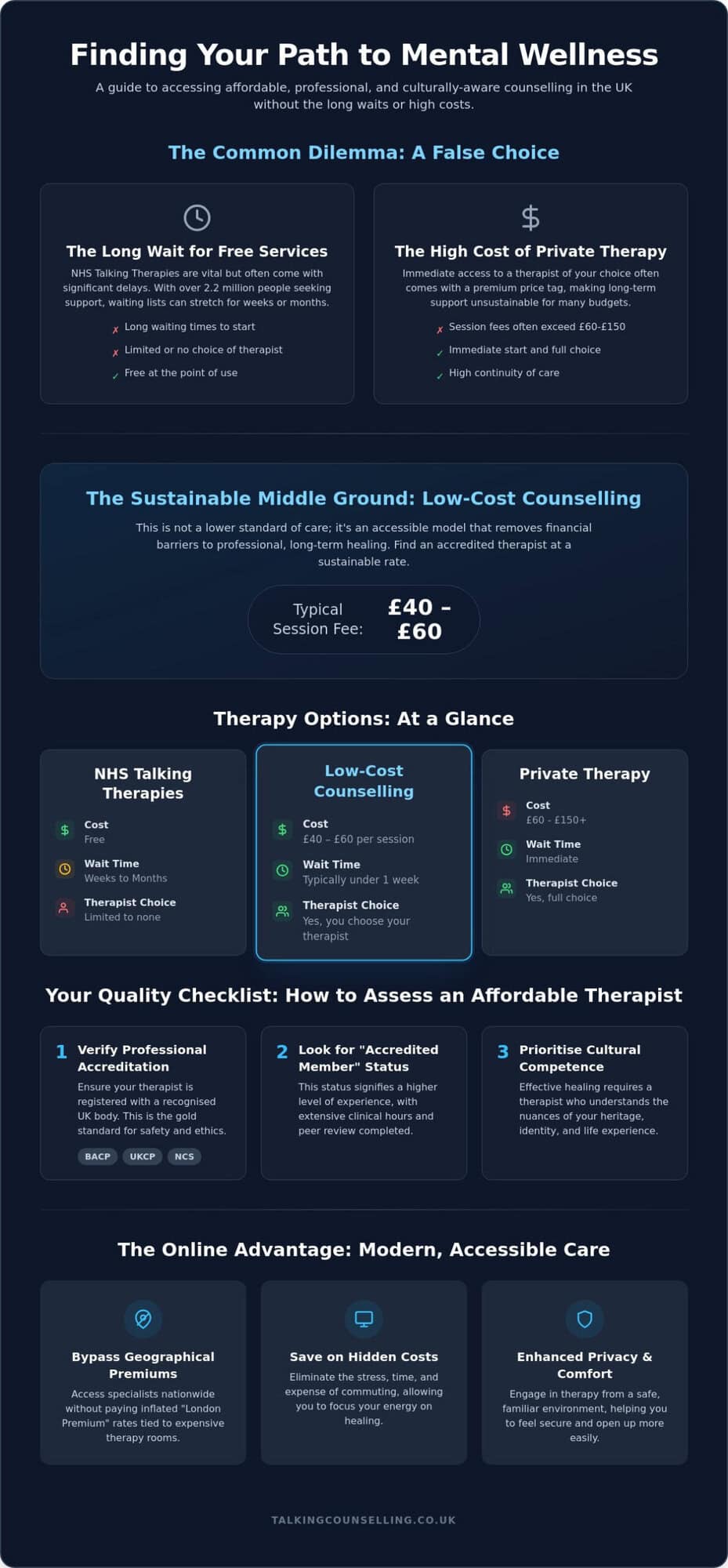
In the UK, the mental health landscape can be broken down into three main tiers:
- NHS Talking Therapies: This is the free, publicly funded option. Whilst an invaluable resource, it is often characterised by long waiting lists (which can be many months), limited session numbers, and less choice over the type of therapy or therapist you see.
- Traditional Private Therapy: This offers immediate access and complete choice, but sessions, particularly in cities like London, can cost anywhere from £80 to £150, making it unsustainable for many.
- Affordable Private Therapy: This is the middle ground. By leveraging technology and efficient practice models, providers can offer sessions with fully qualified, accredited therapists for a more manageable fee, typically between £50 and £65.
Whilst some low-cost services rely on trainee counsellors to keep prices down, a growing number of established practices now offer affordable rates with experienced professionals. This is often achieved by minimising overheads, such as expensive consulting rooms, and focusing on a streamlined online model.
The Difference Between Free, Low-Cost, and Private Therapy
Choosing the right path depends on your immediate needs, your budget, and the level of choice you require. Free services through charities or the NHS are vital but often come with constraints. The primary benefit of affordable private care is the agency it gives you. You have the power to choose a therapist who fits your specific needs, start your journey without a long delay, and build a consistent, long-term therapeutic relationship.
Why Online Therapy is the Modern Standard for Affordability
The rise of online therapy has been the single biggest driver in making quality counselling more accessible. By removing geographical barriers, it has fundamentally changed the cost structure of mental health support.
- Eliminating Overheads: Without the need for expensive therapy rooms in city centres, practices can pass those savings directly on to clients.
- Saving Time and Travel Costs: For those juggling busy lives, the time and money saved on commuting to and from appointments is a significant, often overlooked, financial benefit.
- Creating a Safe Space: Engaging in therapy from the comfort and privacy of your own home can help reduce anxiety and create a sense of safety, allowing for deeper and more open therapeutic work.
How to Assess the Quality of Affordable Therapy Services
When you are investing in your mental health, you deserve assurance of quality and safety. Price is only one part of the equation; the standard of care is paramount. Here are the key factors to consider when evaluating a low-cost counselling service.
Verifying Professional Credentials and Accreditations
Accreditation is the non-negotiable benchmark of a professional therapist. In the UK, look for registration with one of the main professional bodies:
- British Association for Counselling and Psychotherapy (BACP)
- UK Council for Psychotherapy (UKCP)
- National Counselling and Psychotherapy Society (NCPS)
You can verify a therapist’s credentials by searching their name on the registers of these organisations. An “Accredited Member” status often signifies a higher level of experience and training. A professional therapist will also hold comprehensive indemnity insurance.
Beyond the Therapist: The Importance of a Support Structure
An excellent service is defined by its commitment to client care, which extends beyond the individual counsellor. A solo practitioner can be wonderful, but a well-run practice offers an entire support system designed to ensure you have the best possible experience. This is a crucial, yet often invisible, marker of quality.
A high-quality service provides:
- A Professional Matching Process: Rather than simply assigning you the next available therapist, a clinical lead or senior assessor should take the time to understand your needs, preferences, and goals to ensure the best possible therapeutic fit.
- Ongoing Clinical Supervision: Every ethical therapist has a supervisor who supports their work. A good practice ensures this structure is in place to maintain the highest clinical standards.
- A Framework of Care: The support shouldn’t stop after the first session. A dedicated practice will often check in to ensure you feel the counsellor is the right fit and that the relationship is progressing, providing a supportive container from your first enquiry to your final session.
The Role of the Initial Assessment
The initial assessment or introductory call is your first opportunity to gauge this level of quality. It is more than just a formality; it is the foundation of your therapeutic journey. During this call, a trained assessor will listen to your story, and you should feel empowered to ask questions about the process, the therapist’s approach, and how the service ensures a good match.
The True Value of Cultural Competence in Low-Cost Counselling
Effective therapy is built on a foundation of trust and understanding. For that to happen, you must feel seen, heard, and accepted for who you are. This is why cultural competence is not an optional extra; it is a core component of high-quality care, especially in a multicultural society like the UK.
Cultural competence is a therapist’s ability to honour a client’s unique identity, heritage, and lived experiences whilst providing expert clinical support. When a therapist understands your cultural background, it removes the burden of you having to “translate” your life. There is a shared shorthand that can accelerate trust and lead to deeper, more meaningful progress.
Why Shared Heritage Can Lead to Better Outcomes
For many, particularly from minority ethnic or immigrant backgrounds, finding a therapist who “gets it” is a profound relief. It allows you to explore sensitive topics like intergenerational trauma, family dynamics, or societal pressures without fear of being misunderstood. This shared understanding creates a powerful sense of safety and validation, which is essential for healing. If you are looking for support tailored to your personal journey, you may find our guide to individual therapy helpful.
Multilingual Therapy: Breaking Language Barriers
Language is deeply connected to emotion. For some, being able to express complex feelings in their mother tongue is a vital part of the therapeutic process. Services that offer multilingual therapy demonstrate a genuine commitment to accessibility, ensuring that language is not a barrier to receiving the support you need. Similarly, for those wishing to strengthen their cultural ties through communication, Lingua Learn Vietnam provides expert online language instruction for adults.
This commitment to inclusion and accessibility is a core value in the wider health sector; those interested in professional training in this field can explore Student Recruitment and Enrolment Consultancy through Unique Mark for guidance on accredited courses.
Steps to Accessing Sustainable Mental Health Support in 2026
Finding the right support is a process of practical planning and personal preparation. Taking a structured approach can help you find a service that you can commit to for the long term, ensuring you get the most out of your investment in yourself.
- Audit Your Budget: Therapy is a commitment. Look at your monthly finances and determine a realistic, sustainable amount you can dedicate to your wellbeing without causing additional stress.
- Research Providers: Look for practices that are transparent about their fees, their therapists’ accreditations, and their client care process. Prioritise those who charge on a per-session basis rather than demanding large upfront payments.
- Book an Assessment: Use the initial call to test the “chemistry” and ask questions. Do you feel heard? Does their process feel supportive and professional?
- Prepare Your Space: For online sessions, create a private, quiet, and comfortable space where you will not be interrupted. Check your technology (camera, microphone, internet connection) beforehand.
- Commit to Consistency: Therapeutic progress is built on momentum. Committing to a regular weekly or fortnightly session allows you and your therapist to build a strong alliance and work through issues at a steady, productive pace.
Budgeting for Long-Term Wellness
Think of therapy not as a cost, but as an investment. The return on this investment can be profound: improved relationships, better performance at work, and a greater sense of peace and resilience. When compared to other monthly urban expenses, like a gym membership or dining out, therapy offers value that can positively impact every area of your life.
Talking Counselling: Professional Support Designed for Modern Life
At Talking Counselling, we were founded on the principle that everyone deserves access to high-quality mental health care. Born in London and now serving clients across the UK, our online-first practice is designed for the pressures of modern life. Led by BACP-accredited therapist Anh Doan, we have over 15 years of clinical experience in providing compassionate, professional support.
We offer a transparent, affordable entry point for accredited care, with sessions starting from just £50. But our definition of quality goes far beyond the price tag.
Our Approach to Client Care
We believe that an excellent service is built on a foundation of excellent client care. Your journey with us is supported by a dedicated team, not just a single therapist. It begins with a thorough assessment with a senior practitioner who takes great care in matching you with the right counsellor for your specific needs, background, and goals. Our therapists are supported by clinical supervisors, and we are here to ensure the partnership feels right for you, providing a complete framework of support from your first contact to your final session.
We specialise in helping individuals and couples navigate anxiety, depression, life transitions, and relationship challenges. With a deep understanding of the “London pace” of life and a specialism in culturally sensitive therapy, particularly for those of East Asian heritage, we are committed to being the bridge to your wellbeing.
Start Your Journey with a Professional Assessment
Taking the first step is often the hardest part, but we are here to make it as smooth as possible. When you reach out, you can expect a response within 48 hours to arrange your initial assessment. This is your opportunity to be heard and to find out how we can help.
Quality, affordable care is within reach. Begin your path to healing with an affordable assessment today.

Article by
Anh Doan
With over 15 years of experience as an individual and couples therapist, Anh has extensive experience supporting clients living with complex trauma, helping them understand the impact of their experiences, develop emotional resilience, and build healthier relationships with themselves and others
Disclaimer
Disclaimer: This article is for educational and informational purposes only and does not constitute medical, psychological, or therapeutic advice. Reading this content does not create a therapeutic relationship with Talking Counselling. If you are concerned about your mental health, please seek support from a qualified healthcare or mental health professional.
If you need someone to talk to, you can contact Samaritans on 116 123 (available 24 hours a day). For urgent medical advice, contact NHS 111. If there is an immediate risk to life or an emergency, call 999. If you are unable to make the call yourself, ask someone you trust to call on your behalf.