

Multilingual Therapist UK: A Guide to Finding Culturally Sensitive Support
Imagine sitting in a therapy session, trying to describe a nuanced feeling of family duty or cultural heritage, only to find yourself spending the hour explaining your background rather than processing your pain. It is exhausting to act as both the client and the cultural ambassador. If you’ve ever felt that your most profound emotions are being filtered through a lens that doesn’t quite fit, you understand the vital need for a multilingual therapist UK who truly speaks your language.
We recognise that true emotional healing happens when you feel seen and heard without the need for constant footnotes. You deserve a therapeutic partnership where your mother tongue is a bridge, not a barrier. This guide will show you how to find an accredited, culturally sensitive professional who understands your history as well as your words. We’ll explore how to verify credentials with bodies like the BACP, navigate your rights under the Data (Use and Access) Act 2025, and access affordable care that respects your identity.
Key Takeaways
- Understand why expressing yourself in your first language reduces the cognitive load of translation, allowing you to focus on healing rather than finding the right English words.
- Learn how to verify professional standards by checking for BACP or UKCP accreditations to ensure your practitioner meets strict ethical and clinical requirements.
- Discover the specific benefits of working with a multilingual therapist UK who understands the cultural nuances and traditions that shape your unique world view.
- Explore how a personalised matching process can connect you with a professional who shares your heritage, creating an immediate sense of safety and being understood.
- Find out how to access high-quality, affordable emotional support that bridges the gap between your cultural identity and professional mental health care.
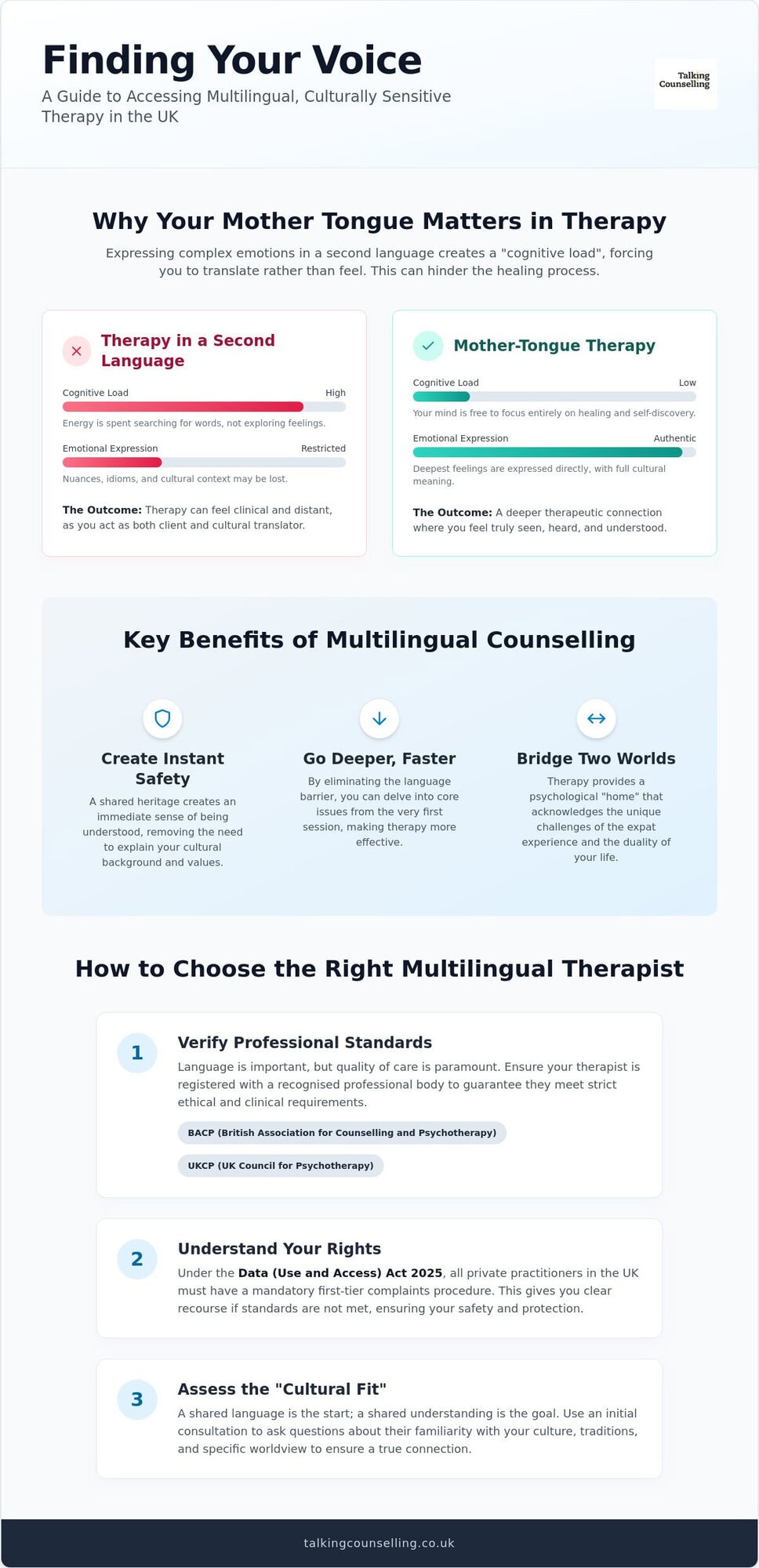
The Importance of Mother-Tongue Therapy in Emotional Healing
Emotions aren’t just thoughts; they are deeply rooted in the sounds and rhythms of our first language. Our earliest memories, from the comfort of a lullaby to the sting of a childhood reprimand, are stored in the language we first spoke. When you experience trauma or joy, your brain often processes these events in your mother tongue. Seeking a multilingual therapist UK is often the first step toward reclaiming that emotional space and ensuring your history is understood without filters. If you’re also experiencing anxiety alongside these cultural pressures, it’s worth knowing that both can be explored together in the right therapeutic space.
Translating your internal world into English whilst in distress creates a heavy cognitive load. You might find yourself searching for the “right” word instead of feeling the emotion itself. This barrier can make the therapeutic process feel clinical or distant. Many idioms and cultural nuances, such as specific concepts of family honour or collective responsibility, simply don’t have a direct English equivalent. Without a therapist who understands these nuances, vital parts of your story can become lost in translation.
The way we communicate emotions is deeply tied to our cultural background; Learning Explorer highlights how these communication styles differ, further explaining why literal translation often fails to capture the depth of our feelings.
Why Cultural Competency Matters
Effective support requires more than a shared vocabulary. It demands an understanding of the unspoken rules that govern your life, such as family hierarchies or community expectations. When your therapist shares your heritage, you don’t have to spend precious time “educating” them on your traditions. This is the foundation of multicultural counselling, which ensures your identity is central to the work. If you’d like to understand more about the types of therapy available, our blog on what talk psychotherapy involves is a useful starting point. Intercultural therapy is a collaborative process that honours the client’s roots and integrates these values into the healing journey.
Overcoming the Isolation of the Expat Experience
Living in a different culture often brings a unique sense of displacement. You might feel like a different person depending on the language you speak. A multilingual therapist UK provides a psychological “home” where you can be your whole self. This sense of safety is vital for those managing the anxiety of the expat experience. It allows for a deeper connection than standard individual therapy might offer because it acknowledges the duality of your life and the specific challenges of belonging to two worlds at once.
How to Choose the Right Multilingual Counsellor in the UK
Finding the right support is a delicate balance of professional expertise and personal connection. When searching for a multilingual therapist UK, it’s easy to prioritise language above all else. However, your safety and the quality of care depend on finding a practitioner who is both linguistically capable and professionally accredited. A shared language provides the comfort, but professional standards provide the safety net necessary for deep emotional work.
Verification of Professional Standards
You should never compromise on clinical standards for the sake of language. In the UK, the titles “counsellor” and “psychotherapist” aren’t legally protected, so you must verify that your therapist is registered with a voluntary professional body like the BACP or UKCP. These organisations ensure that practitioners adhere to strict ethical boundaries. Research into native-language psychotherapy suggests that whilst speaking the same language is powerful, the clinical framework remains the foundation of healing. Additionally, under the Data (Use and Access) Act 2025, all private practitioners must now have a mandatory first-tier complaints procedure, giving you clear recourse if standards aren’t met.
Online therapy has expanded the possibilities for those seeking specialised care. It allows you to access a wider pool of experts across the country, ensuring you aren’t limited by your local geography. This is particularly helpful if you need a specialist in anxiety or trauma who also speaks your specific dialect or understands your precise cultural heritage. Structured approaches such as CBT therapy are also available online and work well alongside culturally sensitive care.
Assessing the “Cultural Fit”
A shared language is a start; a shared understanding is the goal. During an initial consultation, don’t hesitate to ask specific questions to gauge their cultural awareness. You might ask how they view family dynamics in your culture or how they handle topics like collective identity versus individual autonomy. You can find the right support with our accredited therapists who specialise in bridging these cultural gaps. Prioritising an initial assessment ensures that the personality match feels right before you commit to the journey. If you are ready to take that first step, you might choose to enquire about a personalised matching session to find a practitioner who truly understands your world.
Talking Counselling: Accessible Multilingual Support Across the UK
Talking Counselling was established with a clear mission: to bridge the gap between professional mental health care and the diverse cultural identities that make up modern Britain. As a dedicated multilingual therapist UK provider, we understand that accessibility is about more than just location; it’s about finding a space where you are understood on every level. We believe that professional support should be a partnership that respects your heritage whilst providing the clinical expertise you need to heal.
Our online model removes the traditional barriers of geography and high costs. Whether you are seeking support in Guildford, Canary Wharf, or a rural village, our experts are accessible online from the comfort of your own home. We maintain a transparent pricing structure with fees starting at £50 per session — and if cost is a concern, our guide to accessing affordable therapy in London may help. By avoiding the significant overheads associated with central London private clinics, we ensure that high-quality, accredited care remains an affordable option for the communities we serve. Every journey begins with a personalised matching process led by experienced practitioners like Anh Doan, who brings over 15 years of clinical expertise to our practice.
Individual and Couples Therapy in Your Language
Relationships are often where our cultural values and personal identities intersect most sharply. We provide specialised support for both individuals and couples, helping you explore relationship challenges within your specific cultural context. This allows you to discuss family dynamics and traditions without having to explain their significance. For those seeking personal growth, our Individual Therapy: A Compassionate Guide offers deeper insight into how we support your unique path to healing.
Starting Your Journey
We’ve organised our path to support into three clear, manageable steps to reduce your cognitive load and help you feel at ease:
- Assessment: A brief initial conversation to understand your needs and linguistic preferences.
- Matching: Our senior team selects the multilingual therapist UK best suited to your cultural background and clinical requirements.
- First Session: You begin your therapeutic work in a warm, non-judgmental environment designed for your comfort.
Our team acts as a steady, reliable guide throughout this process. We focus on creating a sense of grounded optimism, ensuring you feel safe and seen from your very first enquiry. You don’t have to navigate your struggles alone; we are here to walk with you toward a more hopeful future.
Taking the First Step Toward Culturally Sensitive Healing
Finding a multilingual therapist UK is about more than just convenience; it’s about honouring your identity and ensuring your emotional history is heard in its truest form. We’ve explored how speaking your mother tongue reduces the burden of translation and why choosing a practitioner with BACP or UKCP accreditation is vital for your safety. By prioritising a professional who understands your cultural nuances, you move away from the isolation of being misunderstood and toward a partnership built on genuine empathy.
At Talking Counselling, we work to make this transition as seamless as possible. Our team brings over 15 years of clinical experience to every session, offering affordable rates from £50 to ensure high-quality support is accessible to everyone. You don’t have to navigate your healing journey alone or feel lost in translation. When you are ready to be seen and heard in the language of your heart, we are here to guide you forward. Book your initial assessment for multilingual therapy today and begin the collaborative process of self-improvement in a space where you truly belong.
Frequently Asked Questions
Is online multilingual therapy as effective as meeting in person?
Online therapy is recognised as being as effective as in-person sessions for managing most emotional challenges. It provides a vital link to a multilingual therapist UK who shares your cultural background, even if they aren’t located in your specific town. This model eliminates travel time and allows you to engage in healing from the safety of your own home. For many clients, this familiar setting reduces anxiety and makes it easier to open up in their mother tongue.
How much does a multilingual therapist in the UK typically cost?
Private therapy costs in the UK typically fluctuate depending on the therapist’s level of experience and their location. Whilst city-centre clinics may charge significantly more, many accredited practitioners offer sessions between £50 and £120. We aim to make support accessible by offering professional care starting at £50. This approach ensures you can receive high-quality, culturally sensitive therapy without the financial pressure often associated with private healthcare in central London. For a broader overview of your options, see our guide to affordable therapy in London.
What languages are commonly available for counselling in the UK?
Counselling in the UK is increasingly diverse, with support available in languages such as Arabic, Polish, Spanish, French, and Cantonese. Finding a multilingual therapist UK is often easier through online platforms that aggregate accredited professionals from across the country. If you speak a less common language, these digital services are invaluable. They connect you with a specialist who understands your idioms and traditions, ensuring your sessions are productive and free from cultural misunderstandings.
Can I get therapy in my native language through the NHS?
It is possible to access native-language support through the NHS talking therapies service, although this often involves the use of an interpreter. Whilst this is a helpful service, many find that the presence of a third party can disrupt the intimacy of the therapeutic relationship. Consequently, many individuals prefer to seek private, accredited therapists who speak their language directly. Mind’s guide to finding a therapist is also a useful resource if you are weighing your options.