

Online Trauma Counselling UK: A Compassionate Guide to Healing from Home
What if the most effective place to begin your recovery isn’t a clinical office, but the quiet safety of your own living room? For many, the weight of the past feels like a constant shadow, manifesting as hypervigilance or intrusive memories that disrupt the rhythm of daily life. You might have found that generic support doesn’t quite reach the depth of your experiences, or perhaps the lengthy waiting lists for specialist services have left you feeling stuck. Accessing online trauma counselling uk provides a vital alternative, connecting you with accredited professionals who understand that healing requires both clinical expertise and a deep respect for your unique identity.
We recognise that reaching out is a significant step, especially when you’re balancing a busy schedule or searching for someone who truly understands your cultural background. You deserve to feel safe and grounded again without having to navigate cold, impersonal systems. In this guide, we’ll show you how specialist online therapy can help you process difficult events and reclaim your future. We will explore the benefits of remote support, how to verify UK-accredited credentials, and what to expect as you start this collaborative journey toward lasting peace.
Key Takeaways
- Learn how trauma-informed care prioritises your safety and choice, adapting proven talking therapies for a comfortable digital environment.
- Understand the differences between NHS pathways and private online trauma counselling uk to find the most direct route to specialist support.
- Discover practical steps to prepare your personal space and technology for a secure, uninterrupted healing experience at home.
- Explore the vital role of cultural competency and how a therapist who understands your heritage can help you process systemic or identity-based trauma.
- Recognise the distinction between single-incident and complex trauma to better understand your own journey toward reclaiming a sense of safety.
Understanding Online Trauma Counselling in the UK
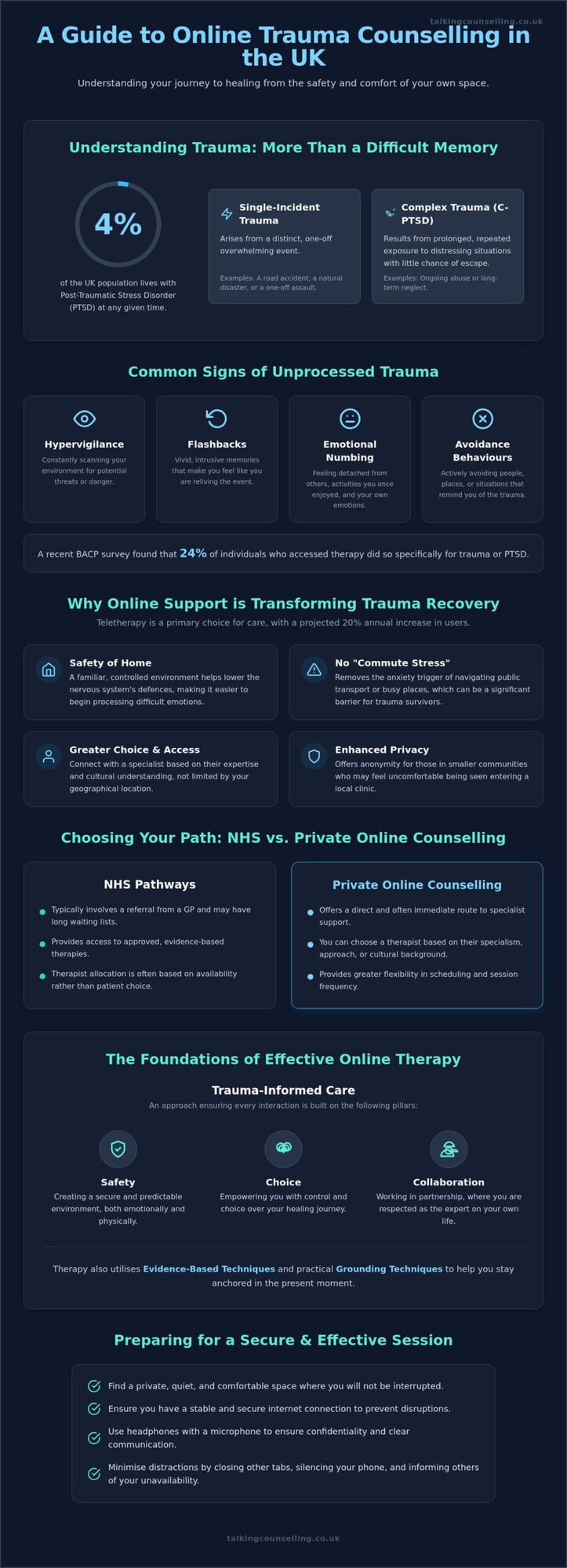
Trauma isn’t just a memory of a difficult event; it’s a physiological response that stays in the body. It happens when a distressing experience overwhelms your internal system, leaving you feeling unable to cope with the emotional aftershocks. In the UK, approximately 4% of the population lives with Post-Traumatic Stress Disorder (PTSD) at any given time. Some people experience single-incident trauma, such as a road accident or a one-off assault. Others navigate Complex PTSD (C-PTSD), which arises from prolonged, repeated exposure to distressing environments where escape felt impossible. Both forms of trauma require a specialist approach that understands how the brain stores these experiences, leading many to explore Remote Neurofeedback as a way to support physiological regulation from home.
The landscape of mental health support has shifted significantly to meet these needs. With a projected 20% annual increase in teletherapy users by 2026, online trauma counselling uk has become a primary choice for those seeking expert care without the barriers of travel. This shift isn’t just about convenience. For many, the “safety of home” creates a controlled environment where the nervous system feels secure enough to begin the delicate work of processing. When you’re in your own space, you have control over your surroundings, which can actually accelerate the healing process by lowering your initial defences.
The Symptoms of Trauma and When to Seek Help
Recognising when you need support is a brave first step. According to a 2026 BACP survey, 24% of people who accessed therapy in the previous two years did so specifically for trauma or PTSD. You might notice constant hypervigilance, where you’re always scanning for danger, or perhaps you experience vivid flashbacks that pull you back into the past. Other common signs include emotional numbing, where you feel disconnected from loved ones, and avoidance behaviours that limit where you go or who you see. In the UK, these symptoms often spill into professional life, affecting workplace productivity and straining personal relationships. Recovery involves finding your “window of tolerance,” which is the emotional zone where you can process intense feelings without becoming completely overwhelmed or shutting down entirely.
Why Online Support is Changing Trauma Recovery
Traditional therapy often requires a journey to a clinic, which can be a significant barrier for those struggling with hyperarousal. Removing the “commute stress” is vital; for a trauma survivor, navigating public transport or busy city centres can trigger anxiety before the session even begins. By choosing a digital path, you’re able to work within an environment you already trust.
Modern practitioners utilise trauma-informed care to ensure that every interaction prioritises your sense of agency and safety. This approach allows you to choose a specialist based on their specific expertise and cultural understanding, rather than being limited by your postcode. Privacy is another crucial factor. Many people in smaller UK communities prefer the anonymity of online sessions over the risk of being seen entering a local high-street clinic. It’s about putting you in control of your healing journey from the very start.
Evidence-Based Techniques Used in Online Trauma Therapy
Modern online trauma counselling uk is built upon a foundation of clinical excellence and deep empathy. It isn’t merely a conversation; it is a structured, evidence-based process designed to help you regain control over your internal world. A recent UK-based clinical trial has demonstrated that these digital methods are highly effective for processing traumatic memories, often yielding results comparable to traditional settings. The core of this approach is trauma-informed care, which ensures your sessions are built on safety, choice, and transparent collaboration. You are always the expert on your own life, and your therapist acts as a steady partner in your recovery.
Grounding techniques serve as the essential starting point for any trauma work. These are practical tools designed to keep you anchored in the present moment if memories begin to feel overwhelming. By establishing these skills early, you create a “safety net” that allows you to explore difficult topics without losing your sense of stability. Whilst the screen provides a physical distance, a skilled therapist remains focused on your non-verbal cues. They monitor subtle changes in your breathing, facial expressions, or posture to ensure you stay within your window of tolerance, pausing or adjusting the pace whenever you need to feel more secure.
Modalities: From CBT to Compassion Focused Therapy
Different people require different tools. Trauma-focused Cognitive Behavioural Therapy (CBT) is often used to help you identify and reframe the intrusive thoughts that can follow a distressing event. If you struggle with deep-seated feelings of guilt or the “inner critic,” Compassion Focused Therapy (CFT) can be incredibly transformative. It works to lower the shame often associated with trauma by fostering self-kindness and emotional resilience. Additionally, Acceptance and Commitment Therapy (ACT) helps you move forward by focusing on your core values, allowing you to build a meaningful life despite the challenges of the past.
Schema Therapy and Long-term Healing
For those who have experienced prolonged or childhood trauma, Schema Therapy provides a deeper framework for long-term change. This approach identifies specific “modes,” which are the emotional states and coping responses we automatically flip into when we feel triggered or threatened. Online sessions are particularly well-suited for the “limited reparenting” aspect of this work, where the therapist provides the consistent, supportive emotional connection that may have been missing in your early years. This process helps heal the vulnerable parts of yourself whilst strengthening your “healthy adult” mode. If you’re ready to explore how these tailored approaches can support your unique story, seeking individual therapy can provide the dedicated space you need to begin.
Choosing the Right Path: NHS vs. Private Online Counselling
Deciding where to seek help is a pivotal moment in your recovery. Whilst the NHS remains a cornerstone of British healthcare, the reality of specialist trauma care often involves significant hurdles. For those seeking online trauma counselling uk, the choice between public and private pathways often comes down to a balance of time, choice, and specific expertise. Current data suggests that the average wait for talking therapies can range from 12 to 18 weeks, yet for complex trauma requiring secondary care, some regions report waits exceeding 18 months. This delay isn’t just a matter of time; it’s a period where symptoms like hypervigilance or flashbacks can become more deeply entrenched, making the eventual work of recovery more intensive.
When you opt for private support, you’re not just bypassing a queue; you’re gaining the power to choose who walks this path with you. In the NHS, you’re typically assigned a practitioner based on availability. Privately, you can interview potential therapists to find a “relational fit”-that sense of being truly seen and understood. When evaluating your options, resources like the UK Trauma Council offer valuable insights into evidence-based standards. Using these benchmarks helps you determine if a service provides the level of care necessary for your specific history, ensuring your investment in your well-being is placed in capable hands.
The Benefits of Private Trauma-Informed Support
Choosing private care allows for a level of consistency that is often difficult to maintain in overstretched public services. You’ll see the same accredited therapist for every session, which is vital for building the trust required to process deep-rooted distress. This path also offers:
- Flexibility: Sessions can be organised around your professional and personal life, reducing the stress of mid-day appointments.
- No Gatekeeping: You don’t need a formal diagnosis from a GP to begin your healing process.
- Tailored Pace: You and your therapist decide how many sessions you need, rather than being limited to a fixed six-week block.
Verifying Accreditation and Professional Standards
Trust is built on transparency. In the UK, you should always check that a therapist is registered with a recognised professional body, such as the British Association for Counselling and Psychotherapy (BACP) or the UK Council for Psychotherapy (UKCP). These organisations ensure that members adhere to strict ethical frameworks and maintain high standards of practice. A truly trauma-informed professional will also engage in regular clinical supervision, a mandatory requirement in the UK that provides an extra layer of safety and oversight for your care. When browsing profiles, look for specific mentions of trauma training and a commitment to cultural sensitivity, as these are markers of a practitioner who understands the nuances of diverse life experiences. Finding affordable therapies that don’t compromise on these professional standards is the most direct route to reclaiming your peace of mind.
Preparing for Online Trauma Therapy: Your Safety Checklist
Engaging in online trauma counselling uk requires a thoughtful shift in perspective. You aren’t just attending a meeting; you are co-creating a sanctuary for your recovery within your own home. In a traditional clinic, the therapist manages the physical safety of the room, but in a digital setting, this responsibility is shared. This preparation is a vital part of the therapeutic process, as it empowers you to establish boundaries and control your immediate environment. You’ll need a stable UK broadband connection and a device that supports secure, encrypted video platforms to ensure your conversations remain entirely confidential and compliant with data protection standards.
Creating a Physical and Emotional Safe Space
Privacy is the cornerstone of emotional safety during a session. If you live with housemates or family, it’s helpful to communicate your need for an hour of uninterrupted time, perhaps by using a “do not disturb” sign or scheduling sessions whilst others are out. Using headphones is a simple yet effective way to ensure that only you can hear your therapist’s voice, which helps you feel more comfortable speaking freely about sensitive topics. Consider your sensory needs to help regulate your nervous system. Lighting should be soft rather than harsh, and having “comfort objects” nearby, such as a weighted blanket, a favourite fidget tool, or a warm cup of tea, can provide physical grounding during difficult moments.
Managing Triggers and Aftercare at Home
When navigating online trauma counselling uk, your aftercare plan is just as important as the session itself. After a deep session, you might experience a “vulnerability hangover,” which is a feeling of emotional exhaustion or heightened sensitivity. Because you don’t have a commute to process the experience, you must build in your own “closing ritual” to transition back to daily life. This could involve changing your clothes, washing your face, or stepping outside for five minutes to signal to your brain that the therapeutic work has paused. If you feel a surge of intensity after the screen goes dark, the 5-4-3-2-1 grounding technique is an excellent tool for home use: identify five things you can see, four things you can touch, three things you can hear, two things you can smell, and one thing you can taste.
Taking these practical steps ensures that your home remains a place of rest, even as it becomes a site for profound healing. If you feel ready to establish your own safe space for growth and recovery, you can book an initial session to discuss how we can support your journey in a way that feels secure and manageable for you.
Talking Counselling: Culturally Sensitive Trauma Support
At Talking Counselling, founded by Anh Doan, we believe that healing is most effective when it feels like a genuine partnership. Our approach is defined by a sense of “quiet confidence,” where professional expertise meets a warm, human touch. We understand that for many seeking online trauma counselling uk, the standard clinical model can feel distant or disconnected from their lived reality. By creating an atmosphere of safety and accessibility, we aim to lower the emotional barriers that often prevent people from seeking the help they deserve. Our goal is to provide a space where you feel seen as an individual, not just a set of symptoms.
Trauma is rarely experienced in a vacuum; it’s often intertwined with our heritage, our identity, and our place within society. We recognise that systemic or heritage-based trauma requires a therapist who doesn’t just listen but understands the nuances of diverse backgrounds. Whilst generic services may overlook these complexities, our practice prioritises cultural competency as a core component of recovery. This perspective allows us to act as bridge-builders, connecting your unique story with evidence-based therapeutic techniques that respect your cultural context. We are committed to providing affordable therapies that remain accessible to the London community and individuals across the UK.
Trust is the foundation of any therapeutic relationship, and it’s often built through shared understanding. Our commitment to offering multilingual therapy and maintaining a diverse team helps foster this connection from the very first interaction. We believe that being heard in a language or cultural framework that feels like home can significantly accelerate the healing process. This inclusive outlook ensures that our support is global in its reach but deeply personal in its delivery, focusing on the possibility of progress for everyone, regardless of their background.
Matching You with the Right Accredited Therapist
Finding the right fit is essential for successful trauma work. We utilise a personalised assessment process to ensure you’re matched with an accredited professional who aligns with your specific needs from day one. Our team has a particular focus on East Asian heritage and other diverse identities, providing a space where you don’t have to explain the cultural context of your distress before you can begin processing it. This balance of professional authority and genuine connection ensures you feel both guided and heard throughout your journey.
For those navigating the intersection of gender identity and trauma, accessing dedicated educational resources can provide additional clarity; you can visit Gender Identity Center to explore their affirming glossary of LGBTQ+ terms and support guides.
Taking the First Step Toward Healing
When you’re ready to begin, the process is designed to be as straightforward as possible to reduce any anxiety you might feel. Your first session is an opportunity to discuss your history in a safe, contained environment and to explore how we can work together. During this initial meeting, you can expect:
- A compassionate, non-judgmental space to share your experiences.
- A clear explanation of how our specialised techniques can support your specific goals.
- A collaborative discussion regarding the pace and frequency of your sessions.
Taking that first step is often the hardest part of the journey, but you don’t have to do it alone. We are here to provide the steady, reliable guidance you need to move from a place of survival to one of growth. You can find out more about our individual therapy sessions and book an initial assessment to start reclaiming your future today.
Reclaiming Your Future with Confidence
Healing from the weight of the past is a journey that requires both clinical precision and a deeply human connection. By choosing online trauma counselling uk, you are prioritising your safety and agency, allowing the recovery process to begin within the sanctuary of your own home. You’ve explored how evidence-based techniques can resolve long-standing patterns and why finding a practitioner who understands your cultural heritage is vital for lasting change. Moving away from the constraints of lengthy waiting lists allows you to take control of your well-being on your own terms.
At Talking Counselling, our BACP and UKCP accredited therapists are specialists in cultural competency, offering a steady and reliable guide for your unique story. As a London-based practice, we are committed to providing affordable per-session fees that ensure expert support remains accessible. You don’t have to navigate these challenges alone; the right partnership can help you move from a state of hypervigilance toward a life of grounded peace. Book your initial assessment with an accredited trauma therapist today and take the first step toward the future you deserve. Progress is always possible when you have the right support by your side.
Frequently Asked Questions
Is online trauma therapy as effective as in-person sessions?
Online trauma therapy is clinically proven to be just as effective as in-person sessions for reducing PTSD symptoms. Research from 2026 indicates that outcomes are equivalent, provided the therapist is experienced in digital delivery. This method allows you to remain in a safe, familiar environment whilst processing difficult memories, which can often lead to steadier progress for those who find clinical offices triggering.
How many sessions of trauma counselling will I need?
The number of sessions you require depends entirely on your unique history and the nature of the trauma you’ve experienced. Whilst single-incident trauma might be addressed in 8 to 12 sessions, complex trauma (C-PTSD) often requires a longer-term commitment to build a foundation of trust and safety. Your therapist will work with you to create a collaborative plan that respects your specific pace and emotional capacity.
Can I do EMDR or other specialist trauma treatments online?
Yes, specialist treatments like Eye Movement Desensitisation and Reprocessing (EMDR) are successfully adapted for online trauma counselling uk. Therapists utilise secure digital tools or specific visual cues on the screen to facilitate the bilateral stimulation required. Most evidence-based talking therapies are now designed to be equally impactful in a remote format, ensuring you don’t miss out on specialist care due to your location.
What happens if I get disconnected during a session whilst feeling distressed?
Your safety is the priority, so we establish a clear “disconnection protocol” during your very first session. If the technology fails whilst you are feeling distressed, your therapist will immediately attempt to contact you via a pre-agreed phone number. This ensures you are never left without support during a vulnerable moment and allows you to reconnect or ground yourself safely with professional guidance.
Is my information kept confidential from the NHS if I use a private therapist?
Private therapy records are kept entirely separate from your NHS GP records unless you specifically request otherwise or there is a serious risk of harm to yourself or others. This independence offers a high level of privacy for those who prefer their mental health journey to remain confidential. It’s a significant factor for many choosing private online trauma counselling uk over public pathways.
How do I know if my counsellor is properly qualified to handle trauma?
You can verify a counsellor’s qualifications by checking the public registers of professional bodies like the BACP or UKCP. Look for practitioners who specifically list trauma-informed training and clinical experience in their professional profiles. A qualified professional will be transparent about their accreditation and will be happy to discuss their specific approach to trauma during your initial assessment.
What is the difference between counselling and psychotherapy for trauma?
Counselling typically focuses on processing specific distressing events and developing immediate coping strategies for daily life. Psychotherapy tends to go deeper, exploring long-term patterns and the root causes of complex trauma, often through modalities like Schema Therapy. Both approaches are valuable, and your practitioner will help you decide which path best suits your current needs and your long-term healing goals.
How much does online trauma counselling cost in the UK?
In the UK, a standard 50-minute session typically ranges from £70 to £120, whilst specialist trauma therapists may charge between £130 and £160. For those on a lower income, many practitioners offer sliding scale fees to make support more accessible, and sessions with trainee counsellors can sometimes be found for as low as £10 to £25. Choosing the right level of support involves balancing your personal budget with the specialist expertise your recovery requires.
Article by
Anh Doan
With over 15 years of experience as an individual and couples therapist, Anh has extensive experience supporting clients living with complex trauma, helping them understand the impact of their experiences, develop emotional resilience, and build healthier relationships with themselves and others
Disclaimer
Disclaimer: This article is for educational and informational purposes only and does not constitute medical, psychological, or therapeutic advice. Reading this content does not create a therapeutic relationship with Talking Counselling. If you are concerned about your mental health, please seek support from a qualified healthcare or mental health professional.
If you need someone to talk to, you can contact Samaritans on 116 123 (available 24 hours a day). For urgent medical advice, contact NHS 111. If there is an immediate risk to life or an emergency, call 999. If you are unable to make the call yourself, ask someone you trust to call on your behalf.